
Backrooms: The Labyrinth of the Mind According to Kane Parsons

Updated: Jul 2
2026© article by Clara Bruno - all rights reserved
reading time: 12 min
Backrooms by Kane Parsons
seen at Ideal cinema in Turin, Italy on 27 June 2026
Kane Parsons and His Debut as a Filmmaker: His Poetics
At the age of twenty, Kane Parsons, who was born and raised in Petaluma, Sonoma County, in Northern California, has made a debut that already displays the assurance and maturity of an auteur. After revolutionising horror on YouTube with his short film The Backrooms (Found Footage), the young filmmaker makes the transition to feature-length cinema, transforming material originally created for the web into a remarkably accomplished and unexpectedly mature work of cinema. This is more than simply a debut: it is a statement of an artist's poetics, revealing a filmmaker who already seems to know with striking clarity the kind of cinema he wants to make. Petaluma Petaluma, in Sonoma County, around sixty kilometres north of San Francisco, is a quiet town in rural California. When Kane Parsons was born there in 2005, it still retained the unhurried pace of suburban America, with its orderly neighbourhoods, shopping centres, and open countryside just beyond the town limits. Its economy had long been rooted in agriculture and dairy farming (for decades it was known as the "Egg Basket of the World", America's leading centre for egg production), and it had not yet become one of the most sought-after residential communities for Silicon Valley commuters.
Perhaps it is no coincidence that Parsons has transformed precisely that sense of everyday ordinariness into a metaphysical nightmare, revealing the unsettling dimension concealed within the most familiar of environments. This is not an influence that Parsons himself has ever acknowledged, yet the association seems entirely consistent with the aesthetic of his work. The Project's Origins on YouTube and A24's Backing
A key element of Backrooms' appeal lies in its origins. The film grew out of the YouTube series of the same name, which Kane Parsons began publishing in January 2022 under the title The Backrooms (Found Footage). Produced almost entirely on his own, using visual effects and editing software readily available to anyone, the short films chronicled the exploration of an impossible space: an endless maze of corridors, walls covered in yellowing wallpaper, flickering fluorescent lights, and a constant electrical hum that transformed seemingly ordinary surroundings into places of metaphysical dread. Their style drew on the conventions of found footage: amateur cameras, rough imagery, spare editing, and an almost documentary realism that made the experience deeply immersive.
Episode by episode, Parsons built an elaborate mythology, introducing the mysterious Async corporation, scientific experiments, surveillance tapes, archival documents, and creatures glimpsed only fleetingly. The result was a fragmented narrative that invited viewers to piece the story together for themselves, almost like digital archaeologists.
This narrative structure captivated millions of young viewers. The series became a global phenomenon, accumulating hundreds of millions of views and inspiring thousands of analytical videos, fan theories, chronological reconstructions, and discussions across YouTube, Reddit, and TikTok. For the digital-native generation to which Parsons himself belongs, Backrooms became what The Blair Witch Project had been for audiences at the end of the 1990s: a work capable of blurring the boundaries between reality and fiction while turning the internet into a vast collective laboratory of interpretation.
When the New York-based independent entertainment company A24, renowned for producing and distributing critically acclaimed films and television projects, entrusted Parsons with directing the feature-film adaptation, it made an unusually bold decision, one that recognised not merely the viral success of the series, but above all the extraordinary visual talent of its remarkably young creator.
Style Analysis: Direction, Cinematography, and Pacing
What we have here is a profoundly unsettling horror film, one that rewrites the conventions of the genre. The film is a visually striking experience, characterised by a refined aesthetic construction.
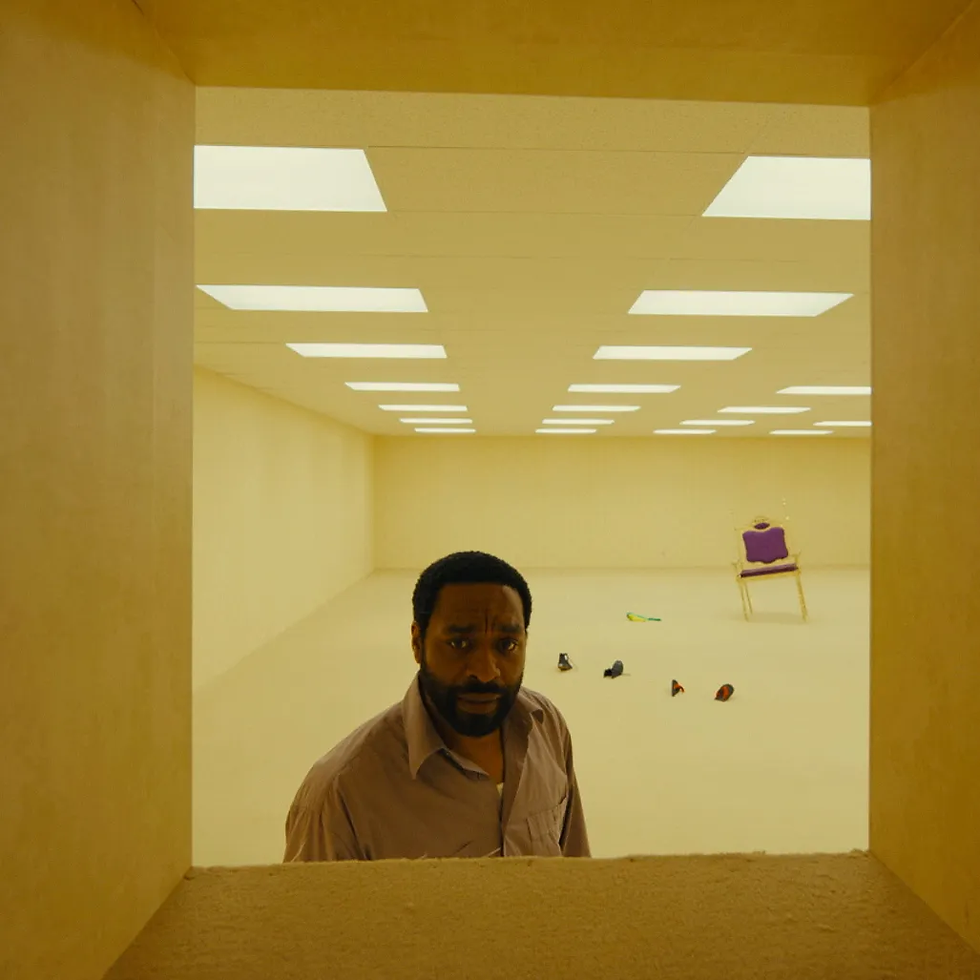
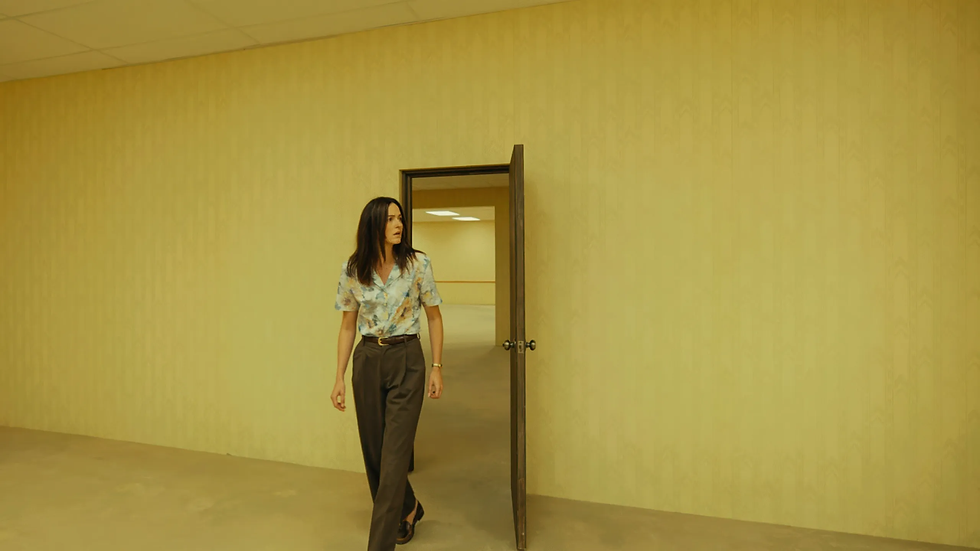
Set in 1990, Backrooms genuinely feels like a film made during that period. Parsons deliberately rejects the frenetic editing and hyperkinetic aesthetic of contemporary horror in favour of direction that is slow, restrained, and patient. Camera movements are measured, the pacing deliberately unhurried, and suspense arises from anticipation rather than shock. The cinematography, with its characteristic faded yellow VHS palette, reinforces the impression of watching a forgotten cinematic artefact, as though the film had lain undiscovered in some analogue archive for more than thirty years. It is an aesthetically assured choice, one that makes the gradual loss of contact with reality all the more disturbing.
A surprising aspect to highlight is that in Kane Parsons' viral YouTube shorts, his backrooms were completely computer-generated; instead, in the movie, the production company A24 built a 30,000-square-foot set!
Comparison with Stranger Things
Despite its strong originality, Backrooms openly engages with one of the most influential science-fiction imaginaries of the past decade: Stranger Things, the television series created by the Duffer Brothers and released on Netflix from 2016 onwards. At the heart of that series too lies the existence of a parallel universe, the so-called Upside Down, which closely mirrors the real world but in a corrupted, decayed and deeply hostile form.
The Backrooms seem to move in a similar direction: they are a copy of our universe, yet stripped of life, distorted in scale, emptied of human presence, and reduced to an endless sequence of deserted offices, corridors and anonymous rooms, unexpectedly inhabited by dangerous creatures. Parsons, however, pushes this idea into an even more radical territory.
Where the Upside Down in Stranger Things still retains a recognisable narrative structure and its creatures remain clearly identifiable, the Backrooms constitute an abstract space in which unease arises primarily from the architecture itself and from the sense that reality has ceased to operate according to its own rules. More than a homage, it feels like the evolution of an idea: the parallel universe is no longer simply the “dark side” of our world, but its imperfect replica, one that, precisely because it is so close to the original, becomes infinitely more disturbing. Characters
Alongside the extraordinary Chiwetel Ejiofor, in the role of Clark, the female lead is played by Renate Reinsve, the Norwegian actress who, after starring in The Worst Person in the World (2021) by Joachim Trier, for which she won the Best Actress award at the Cannes Film Festival, has become one of the most refined and recognisable faces of European independent cinema.
Reinsve once again confirms her ability to give substance to fragile yet enigmatic characters, here embodying the psychologist Mary, a melancholic woman haunted by a childhood trauma (her mother’s psychiatric illness) and gradually consumed by obsession. Her elegant and magnetic screen presence provides the perfect counterpoint to the mental chaos that permeates the narrative.
Plot
The story begins when Clark, a former architect who now runs a mediocre furniture shop, discovers in the basement an entrance to the mysterious Backrooms: a labyrinth of corridors, yellowed rooms and endless spaces that appear to exist outside reality, at an inexplicable physical, temporal and psychological threshold. It is a gateway into a deserted, imprisoning place. The emptiness of this liminal environment evokes a sense of estrangement and nostalgia. It feels deeply familiar, yet lacks any human presence, conveying a subtle but persistent unease.
These Backrooms initially appear as a discovery to be documented, but quickly turn into a journey of no return. When Clark disappears, his psychologist Mary decides to search for him (in a kind of reinterpretation of the Orpheus myth), entering the labyrinth herself, a space that shifts and mutates according to the memories of those who enter it. Critical Interpretation: Clark’s Madness
Yet the film’s true horror does not lie solely in its impossible architectures or the creatures that inhabit them. Backrooms is, above all, a story about madness.
My interpretation (which is in no way confirmed by the film itself, but rather a reading I consider plausible given the work’s deliberate ambiguity) is that Clark, gradually consumed by his own mind, becomes the true perpetrator of the narrative: he is the one who kills his colleague Kat, the two young videomakers involved in the exploration, and ultimately Mary as well.
The Backrooms would then not be merely a supernatural location, but the physical manifestation of his psychosis: a mental space in which guilt, memory and violence ultimately converge.
Parsons deliberately leaves multiple readings open, avoiding any definitive explanation, and this radical ambiguity constitutes one of the most compelling aspects of the film.
The Window Within. Therapeutic Symbolism
Another interpretative key is offered by the character of the psychologist Mary, who throughout the film we learn was herself a traumatised child, raised by a mother suffering from severe psychiatric disorders and later institutionalised. In her book The Window Within, she proposes a path towards liberation from the psychological blocks we construct out of fear of suffering, as though pain compels us to build ever narrower and more inaccessible inner rooms.
(The psychologist tells Clark: “As an adult, you are still trapped at the starting point.” “When we experience pain, we begin to expect it; we think, ‘I know this path, I know where it leads.’ Now I ask you: are you willing to create a new path, to see where it leads?”)
Backrooms thus also becomes the representation of those mental labyrinths into which we retreat in order to protect ourselves, but which ultimately turn into prisons: an invitation to recognise our closed rooms and to search within ourselves for the window through which we might once again breathe in reality. Yet, eventually, does also Mary's mind collapse?
Phil's Ambiguity; the Team of Scientists Studying the Backrooms. What Are the Backrooms?
Finally, there is the character of Phil, played by Mark Duplass. He is probably the most enigmatic element in the entire narrative. Three times throughout the film he appears as a scientist -an expert in imaging and magnetic resonance- associated with the mysterious organisation Async, which is engaged in monitoring or studying the Backrooms. On another occasion, however, he appears as an ordinary family man, sitting in his living room with his wife and two daughters. It is never made clear whether Phil belongs to the real world or whether he represents yet another layer of the labyrinth. The film offers no definitive answer, and this uncertainty is entirely deliberate: Parsons prefers to leave the audience suspended in doubt, suggesting that even the apparent return to normality may simply be another room within the Backrooms.
It seems that the scientists working for Async are not actually doomed to become lost inside the Backrooms, because they wear heavy protective suits that allow them to avoid becoming trapped there. They are able to enter the Backrooms and study them: they install cameras, place silhouettes equipped with audio recordings, and Phil serves as their leader and coordinator.
On the contrary, once an ordinary person enters the Backrooms without any protection and experiences them firsthand, they remain trapped there indefinitely, provided they are not killed by the monster, as happened to Clark and the two filmmakers (although that monster may itself be a manifestation of Clark's own mind).
The suggestion is that the Backrooms are a kind of mind, because the people trapped inside remain there like memories: slightly dejected, almost lifeless, motionless, their faces distorted because you no longer remember exactly what they looked like. They simply stand there, frozen, doing nothing.
The Backrooms therefore contain the Async scientists; they contain these still-lifes, people who have become trapped as imperfect memories, which echo the strange, misshapen piles of furniture that likewise seem to be distorted memories. There are also birds that have apparently wandered into the Backrooms by accident. AI and the Freudian Uncanny (Das Unheimliche)
In my opinion as a viewer and a film critic, I think there is another strand of suggestion running through Backrooms, one that takes on particular significance in light of Kane Parsons’ own statements. The director has expressed a deep scepticism towards artificial intelligence: while acknowledging its remarkable efficiency and its ability to dramatically accelerate creative work, he fears that AI compresses human imagination. Parsons has stated that, if he could press a magic button to make artificial intelligence disappear, he would do so without hesitation.
Perhaps it is not a coincidence, then, that in the Backrooms reality always appears slightly wrong. The environments resemble our world, yet something continually slips out of place: proportions are distorted, spaces are replicated with subtle imperfections, objects are familiar and yet unsettling, like copies that have lost their original.
It is impossible not to think of AI-generated images, capable of reproducing reality with striking accuracy but often betrayed by imperceptible details that reveal their artificial nature. This, of course, is my personal interpretation, but it is tempting to see Parsons’ Backrooms as a metaphor for a synthetic reality: a world that resembles ours without truly being it, an imperfect replica that produces the kind of disorientation described in psychoanalysis by Sigmund Freud as das Unheimliche (“the uncanny”; das Heim, the home; heimlich, familiar, domestic; unheimlich, “not familiar” or “that which renders the familiar strange”).
Freud was developing an insight already present in the writings of E.T.A. Hoffmann, who described “the uncanny” as a particular form of anxiety arising not from something entirely unknown, but from something familiar that suddenly becomes alien.
Parsons constructs an universe that appears as a copy of our own, but an imperfect one. Every room is almost right, every perspective almost correct, every detail almost real. It is precisely that “almost” that generates unease.
The Backrooms are the triumph of the uncanny: they do not frighten us because they are different from our world, but because they resemble it too closely.
As Freud wrote, “Anxiety does not arise from absolute unfamiliarity, but from the return of something we know, which for some reason appears suddenly distorted.”
In the film, the everyday world is stripped of its function, leaving only its unsettling, hollowed-out shell. Soundtrack
A special mention must also be made of the soundtrack, one of the film’s most accomplished elements. The score, composed in collaboration with Edo Van Breemen with direct creative input from Kane Parsons himself, avoids the conventional orchestral crescendos of cinematic suspense. Instead, it constructs an electronic soundscape made of ambient noise and minimal textures.
The result intensifies the sense of disorientation, turning the Backrooms into a space that seems to breathe. It is no surprise that Parsons, beyond being a director and visual effects artist, has for years also cultivated an active practice as an electronic musician: his sonic sensibility is an integral part of his cinematic vision. Critical Conclusion The film ends on an ambiguous note, and the fate of its protagonists remains unclear and unresolved. We cannot figure out whether the person is still inside the maze or has returned to the real world. And, what is most unsettling, it is unclear whether it even matters.
Ultimately, Backrooms is a work that uses horror to interrogate memory and depression as a form of identity dissolution. We are faced with the beginning of a career that seems destined to leave a profound mark on contemporary cinema.
At just twenty years old, Kane Parsons demonstrates a command of space, rhythm and imagery that is rare for a debut filmmaker. His labyrinth is not merely a place to traverse, but a state of consciousness from which it is impossible to emerge unchanged. Affinity with Spider by David Cronenberg (2002), starring Ralph Fiennes
Spider does not present us with a killer in the conventional sense, but rather with a deeply fractured mind: the protagonist inhabits an unstable reality in which memories may be defensive reconstructions, hallucinations, or distorted interpretations of trauma. This is precisely where the key issue emerges: the viewer is never granted access to a fully reliable objective truth.
If we connect this to Kane Parsons’ Backrooms, the parallel that comes to mind works primarily along one axis: the crisis of the reliability of reality.
In Backrooms, reality is not merely ambiguous, it is “slippery”. It is unclear where the coherent world ends and the liminal one begins, and the viewer is trapped within a system of clues that never resolves into a definitive whole. In Spider, by contrast, the structure is more psychological: the world appears coherent, but may in fact be an unstable mental construction.
Points of similarity between these two remarkable films: in Spider, the protagonist’s mind can distort events to the point where even moral certainty becomes unstable (real guilt vs perceived guilt); in Backrooms, the very perception of space and the rules of the world break down, but we do not know whether it is the protagonist’s mind that has distorted them; in both cases, the viewer is forced to experience the film without any definitive anchor point.
The impossibility of clearly determining reality is a powerful connecting thread between the two works. Spider, as a psychological horror, functions as a system in which guilt, memory and reality are continuously renegotiated by the protagonist’s mind. Backrooms is more of an “environmental-external” horror, but it shares elements of instability of reality and a psychiatrically distorted protagonist, as in Cronenberg’s film. I Wonder Pictures: A Worthy Italian Distributor
Credit must be given to I Wonder Pictures, which had both the intelligence and the courage to bring to Italy a work as unusual as it is fascinating, once again confirming its commitment to some of the finest international independent cinema and emerging filmmakers.
Thanks to the Bologna-based distributor, some of the most interesting films on the contemporary international scene reach Italian cinemas, allowing works far removed from blockbuster logic to find their place on the big screen.
There remains, however, a sense of regret: Backrooms was released in Italian cinemas exclusively in a dubbed version. A film so carefully constructed around sound, pauses, vocal inflections and an almost documentary-like realism would have benefited greatly from being presented also in its original version with subtitles. That would have been the best way to appreciate the performances and the subtle sonic texture envisioned by Kane Parsons. Some subtle language meanings and implications always get lost in translation.



google