
Factory 1895: coffee culture and Lavazza's Turin story

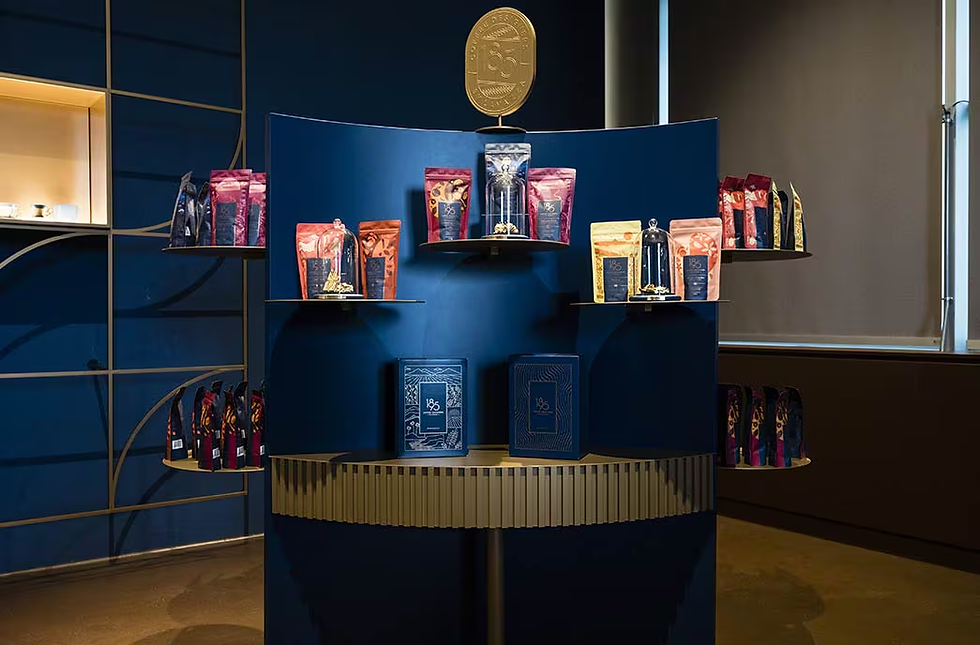
© 2026 article by Clara Bruno - all rights reserved reading time: 2 minutes Turning coffee into an object of knowledge, placing agronomy, technology, memory, sensibility and a culture of taste on an equal footing: this is what happens at Factory 1895, which is far more than simply a ‘showcase’ for the company.
Coffee is a raw material, a daily ritual, and has revealed its own geography, its own history, in a kind of sensory 'grammar'.
In Turin, where in 1895 Luigi Lavazza opened his first grocery shop, on the corner of Via San Tommaso and Via Barbaroux, in the city’s historic centre, before moving as early as 1910 to Via San Tommaso 10, coffee returns to its origins to tell its story through an exploration of the world of speciality coffee. The journey begins in the places where coffee originates, among terroir, plantations and fincas, where the coffee designer’s task is to seek out and select exceptional varieties. The beans then undergo a sophisticated roasting process, in which technological innovation and human expertise must necessarily coexist: the machine guarantees precision, but it is the master roaster’s experience that interprets the raw material and determines its profile. Technology expands the possibilities of human skill; it does not make it redundant. When craftsmanship is rooted in knowledge, innovation does not erase it: it makes it more demanding.
Factory 1895 thus revives an ancient yet thoroughly contemporary conception of craftsmanship: to know a product is to understand its origins, follow its transformations and, ultimately, learn to recognise its qualities through the senses.
Factory 1895 was born from research into and a reinterpretation of a 1930s recipe book, together with the preservation and reinterpretation of the company’s historic achievements over time, for example, Lavazza was the first company in Europe to adopt an innovative fluid-dynamic system.
The tasting
The Coffee Cave, (the ‘cellar of coffee’), introduces visitors to the aromatic complexity of coffee, transforming tasting into an education of the palate. Learning to distinguish aromas, fragrances and subtle nuances means acquiring a language capable of expressing perception.
In this Turin story, a small nineteenth-century grocery shop has grown into an international company that regards coffee not only as a product, but also as a material to be understood. Industrial history is intertwined with the history of human relationships. The supply chain is an economic chain, but in this case it is also a network built on trust.

Comments